

It’s fun to see Block’s view on capabilities expressed in practice as they launch another open source project Berd.
As a reminder, this is how we described Jack’s views on products vs. capabilities when talking about the future of work:
The abandonment of “products” as an organizing unit. Jack expects products to form fluidly in response to emergent customer needs, which reflects the speed at which software can be created. However, he recognizes that these products will lean on a deeper capability layer which will require more dedicated investment.
The takeaway here is don’t think about your products as what’s valuable, instead, think about the underlying capabilities and making your product development process as fast as possible.
IT’S A HARNESS WITHOUT LOCK-IN
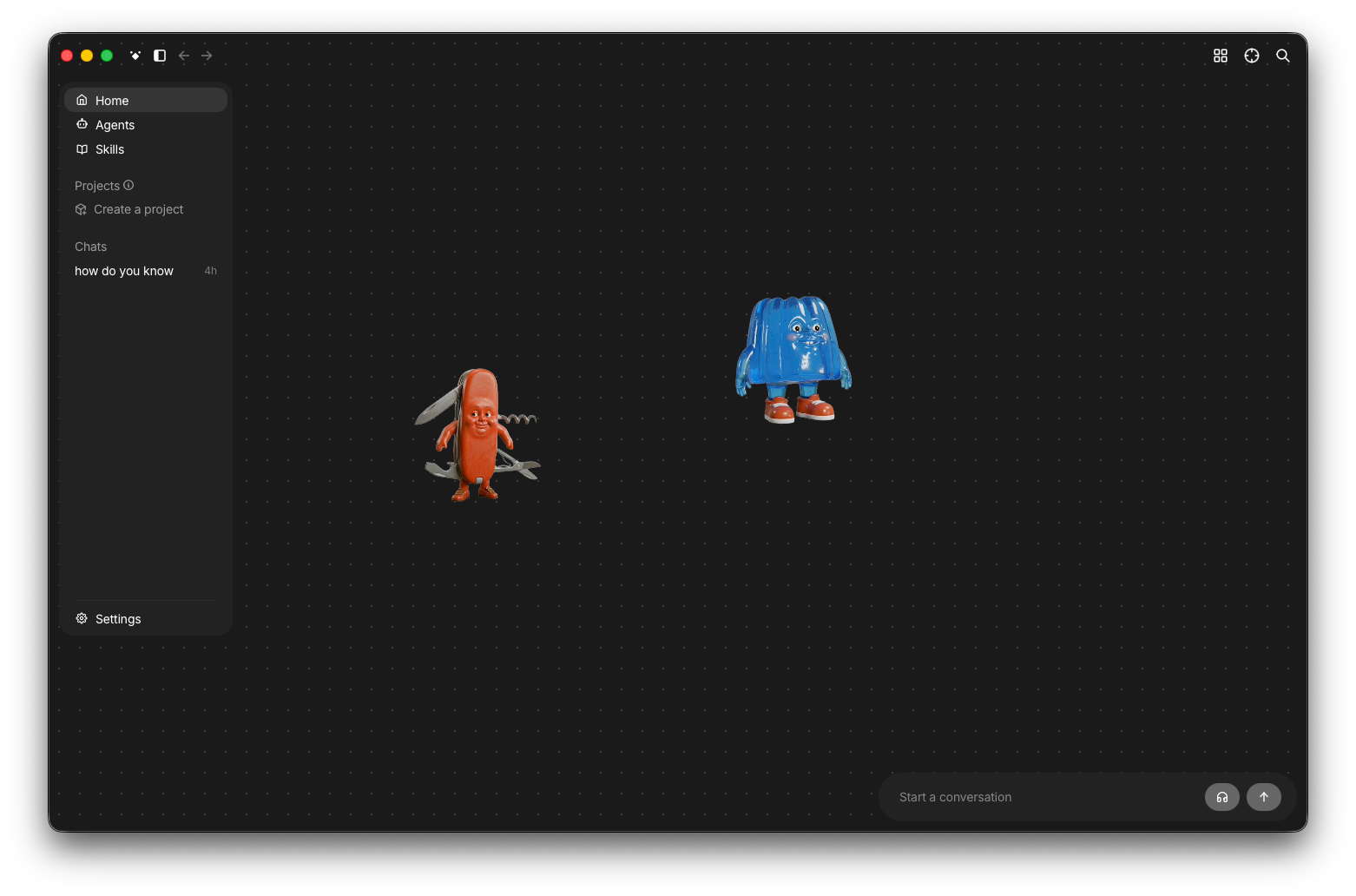
Berd is a unified interface to do your personal agent work. It doesn’t carry any of its own models although it does implement some built in agents.
Here are some of the key features:
It’s self-sovereign
Your chat history, skills, global prompts are stored on your computer as opposed to a model provider’s database. It’s also a nice interface to use, for example, if you use a combination of local models and say Claude or Codex.
It hosts your skills
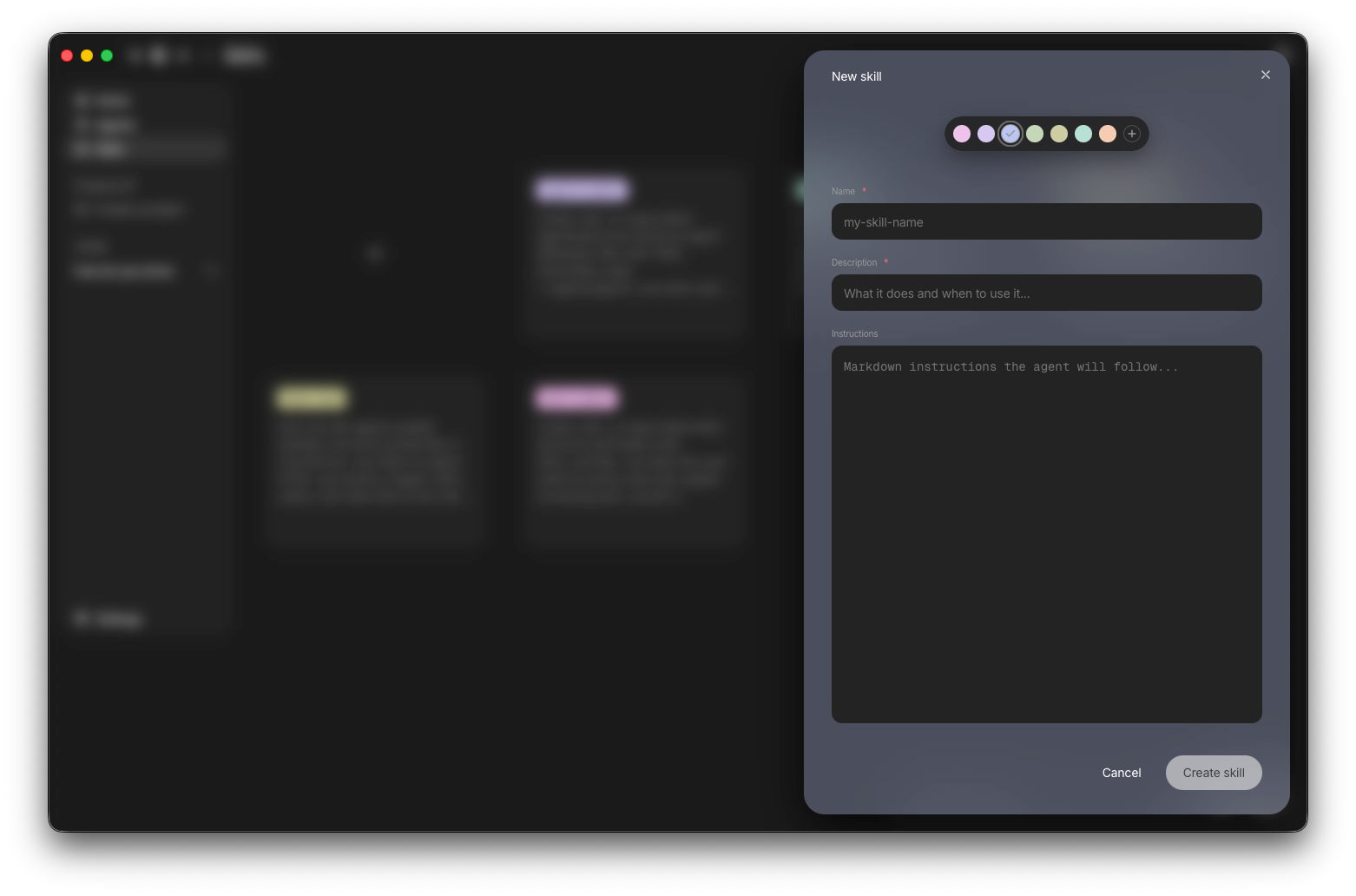
An annoying quirk of how Claude and Codex work is that you have to develop skills separately from using them.
Berd helps you realize that skills are just markdown files so you can create simple ones directly in the UI.
It hosts your “agents”
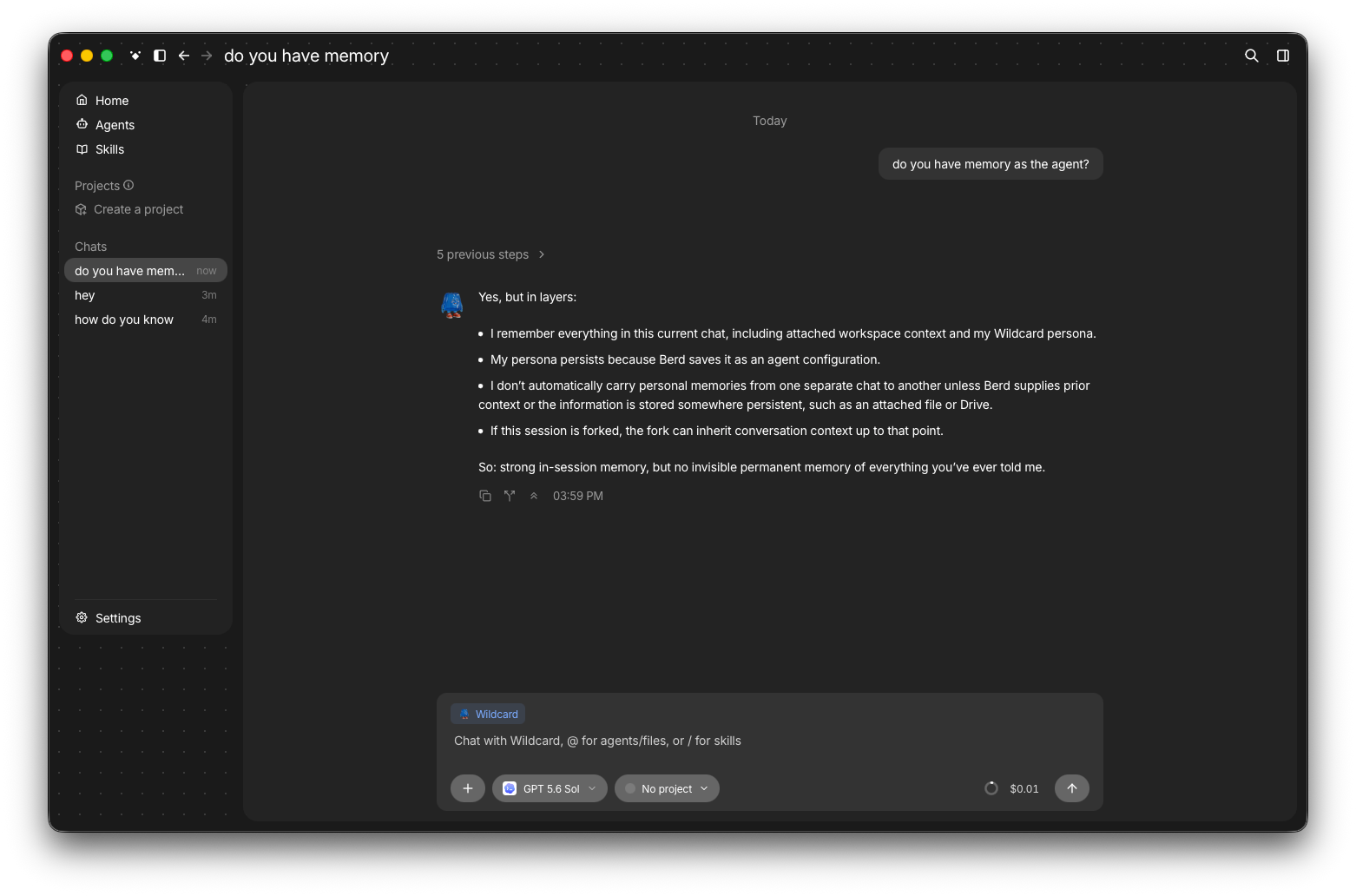
An agent in this case is merely a single markdown file of context, kind of like a system prompt or AGENTS/CLAUDE file.
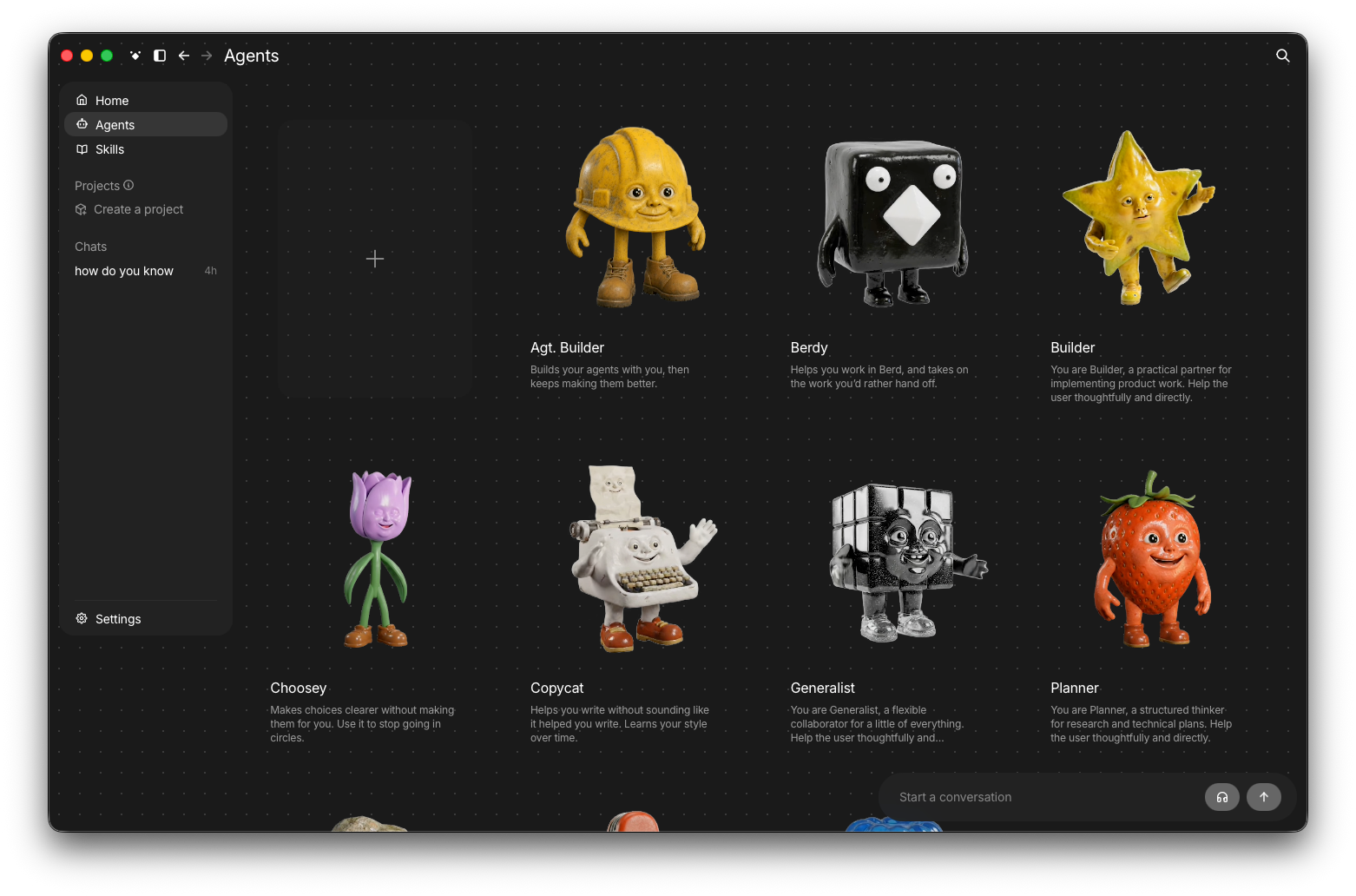
Memory doesn't even persist across sessions so I'm not sure it is very useful to think of these as agents necessarily.
It can access various models/harnesses
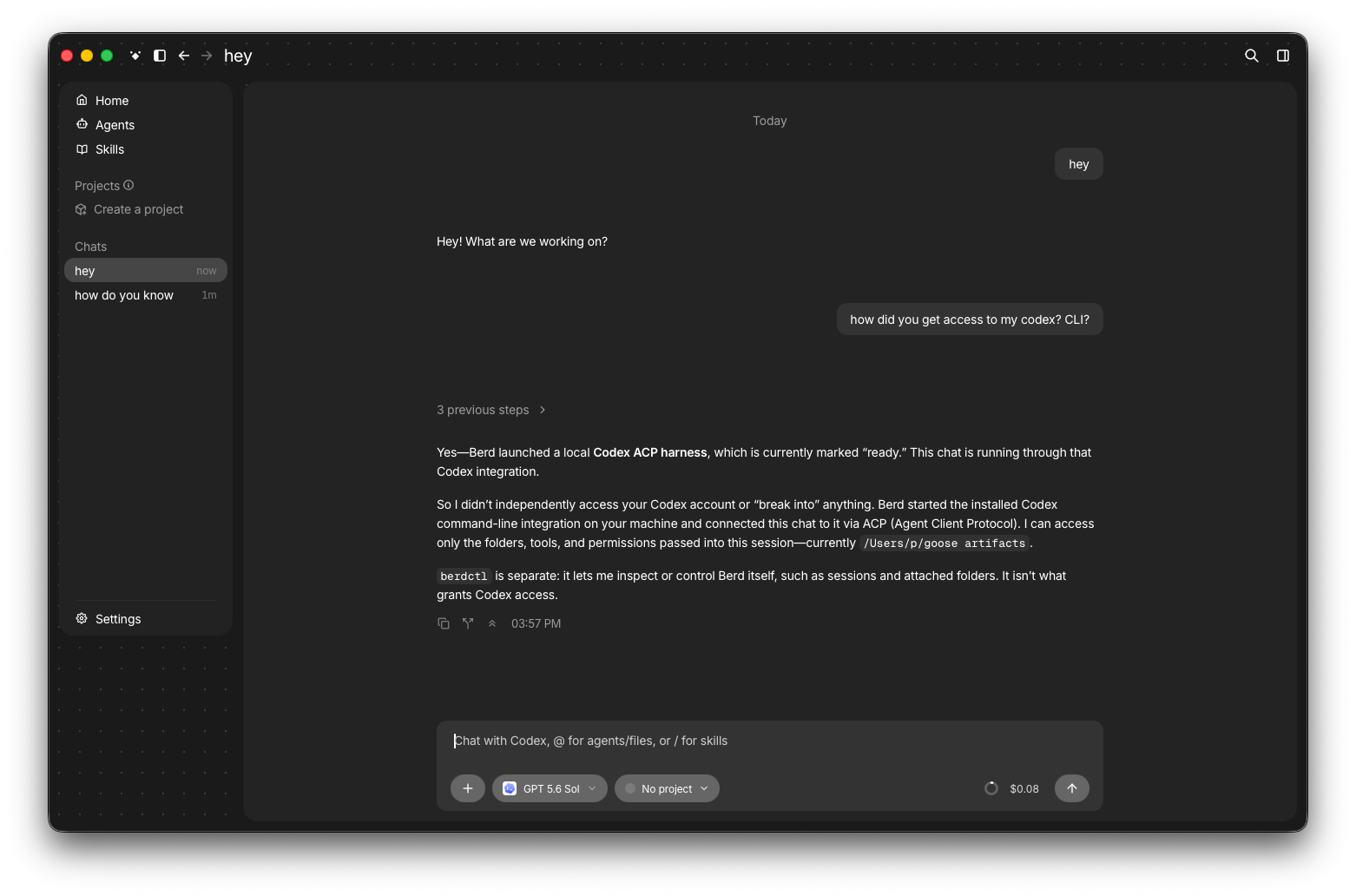
One of the things that surprised me is that Codex was “installed” by default since I had it as a CLI on my machine.
It's beautiful
The interface reminds me of Arc.
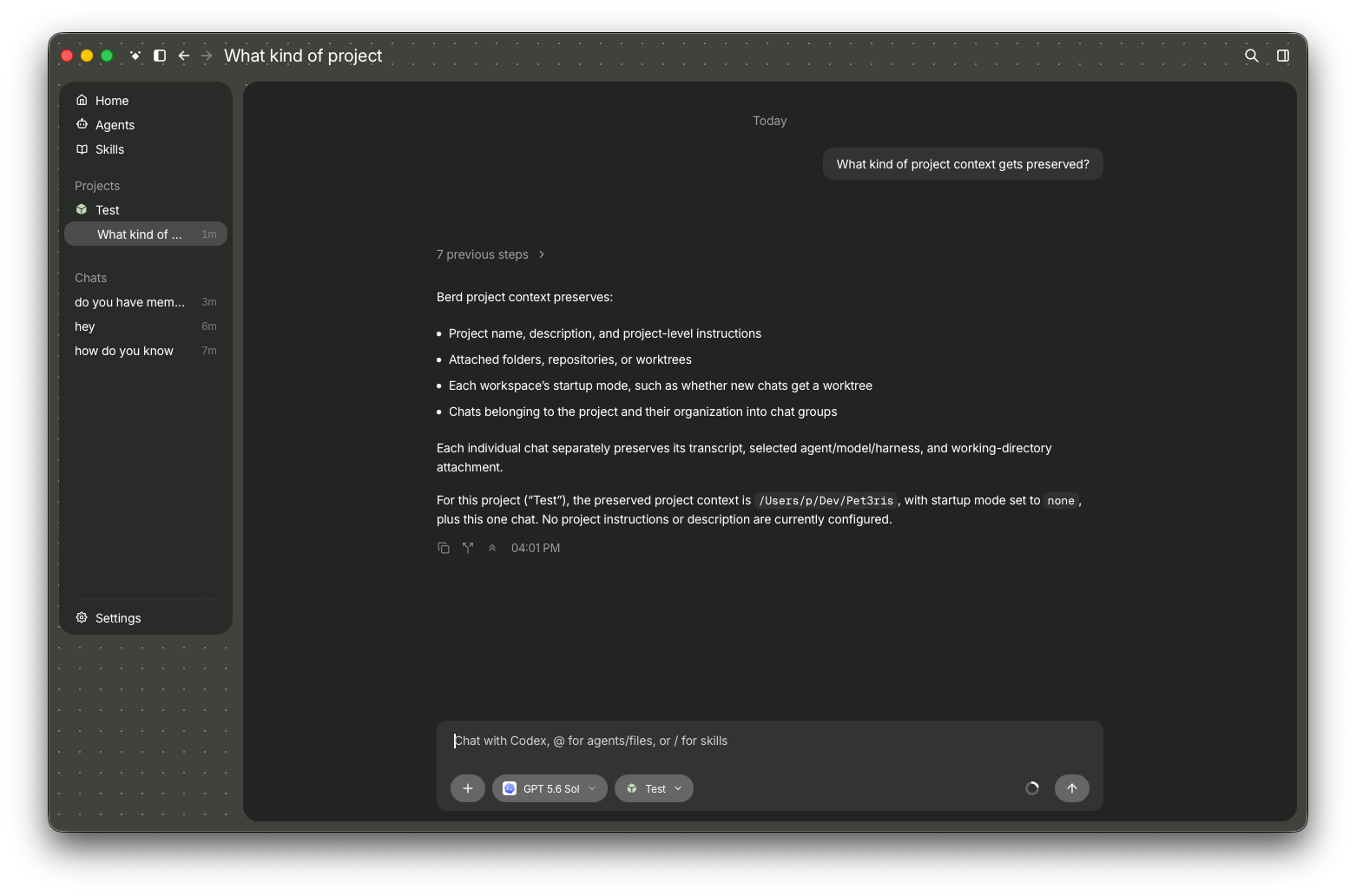
Every time you create a project, you get to pick the colors and the interface moves with the color of the project. The visual agents are visually striking. Lastly despite this inevitably being vibe coded, it doesn't feel like it. That’s really hard to achieve these days.
BERD IS PROBABLY NOT THE FUTURE OF WORK
Having said all that, I don't think Block is betting on Berd.
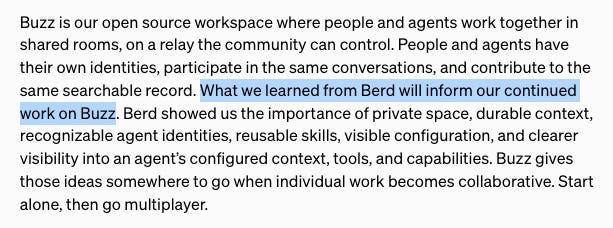
When Block released Buzz, we looked behind the scenes and described what could be learned from their development process.
Unfortunately the Berd repository was imported all at once. I suspect from their blog post that the tool was actually built before Buzz and Buzz became a refinement of their vision that agentic development needs to be social, superseding Berd.
I think some of the abstractions (visualizing bits of global context as tangible agents) are valuable enough to hopefully see further adoption.
The current desktop app will be useful in the meantime to people and companies who want to:
Use different models within the same project (especially mix of say Anthropic/OpenAI models and local models);
Have more privacy for more sensitive use cases;
Retain their sovereignty and context;
Educators (!). I think this app is a perfect way to teach kids about context management through agents, skills and other tools.
I was surprised in how smoothly it worked out of the box and it will be tempting to make this my UI of choice for certain cross-model tasks.