

In From Hierarchy to Inteligence Jack Dorsey and Roelof Botha explain how Block is adapting their organization to AI:
At Block, we’re questioning the underlying assumption: that organizations have to be hierarchically organized with humans as the coordination mechanism. Instead, we intend to replace what the hierarchy does. Most companies using AI today are giving everyone a copilot, which makes the existing structure work slightly better without changing it. We’re after something different: a company built as an intelligence (or mini-AGI).
The article is a worthwhile read and traces key organizational developments from the Roman Empire to present day.
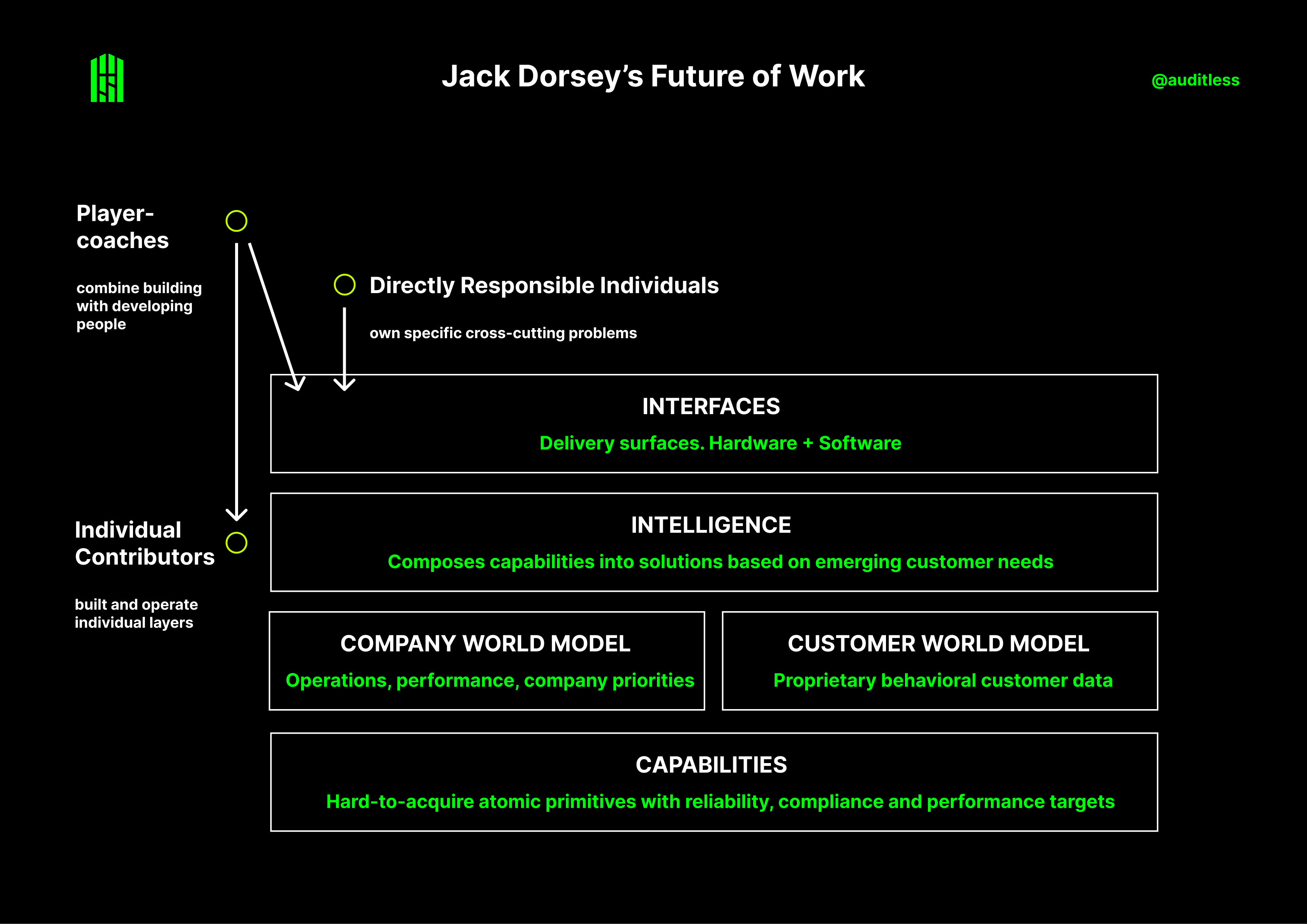
Here’s my visual summary of the org structure the authors present:
At the core, there are 4 layers;
Capabilities, which are bigger than infrastructure but smaller than products;
A Company world model, the type of context that managers would typically convey around the company’s operations, performance and strategy but entirely consumable by LLMs AND a Customer world model, behavioral customer data also consumable by LLMs;
Intelligence, which are purpose-built solutions/products from the capabilities
Interfaces, which are the delivery surfaces and include apps, and hardware
Humans operate at the edges:
Individual Contributors contribute to some of the layers as specialists;
Directly Responsible Individuals take ownership of cross-cutting problems or metrics
Finally, Player-coaches, both develop people and directly contribute.
WHAT’s NEW
There are a couple things that are implicit and draw my attention here.
The abandonment of “products” as an organizing unit. Jack expects products to form fluidly in response to emergent customer needs, which reflects the speed at which software can be created. However, he recognizes that these products will lean on a deeper capability layer which will require more dedicated investment.
The takeaway here is don't think about your products as what’s valuable, instead, think about the underlying capabilities and making your product development process as fast as possible.
The system is trending towards closed loop. Note that the intelligence layer is able to prioritize what we currently see as “software work” without dedicated product managers and roadmaps. A theme we talk about in Default to Closed Loop.
Everyone works on the system. While it’s obvious that everyone in this organization is a consumer of “the system”, the true difference from status quo is that everyone is also a contributor. Either they are an IC or player-coach directly improving certain parts of the system from an ability lens or they are a Directly Responsible Individual who is optimizing how a system is achieving a specific goal. Humans at the edges are also continuing to adjust the world models in line with reality by injecting feedback and data.
All this reminds me of something very familiar.
Jack reinvented management consulting?
Jack focuses on no management as an innovation but that is already how management consulting firms like McKinsey are structured:
Each consultant had a personal development lead (coach?) focused on assessment;
Project leads are assigned on a transient basis to lead 2-3 month projects (which is similar to how Jack frames DRI tenure). Both internal and external projects are essentially structured the same way;
The Firm has a broad set of indexed knowledge documents and each consultant in the system is tagged for the expertise they have.
It's amazing how close McKinsey’s operating model is to this one which makes me even more convinced it will work.
Of course, the big improvement here is the ability to centralize context and add an intelligent delivery mechanism (as opposed to a purely consultant led delivery mechanism) and that is very exciting.