


Some of you are reading this on a Mac but did you know that the entire category that Macintosh pioneered wasn’t obvious at the time?

This is the exact moment where Jobs (then at NeXT) explains how there is a market for “workstations” targeted at professionals outside of science & engineering and draws neat circles around the markets that Apple focused on for the following 2 decades.
With the introduction of LLMs, it’s not obvious how to apply this type of analysis going forward or whether it's even possible.
In the past, the future was known to a few very smart people, but now I fear the oracle is going dark for all of us.
MARKET BOUNDARIES MATTER
Circles on a whiteboard need to be formalized so let me say that two points are on the opposite ends of a market boundary if the potential customers have different needs. Picking the right threshold for different is more of an art than a science but it’s an art that pays more than doing science.
Finding the right circles to bet on is the way investors, Founders and even early employees create wealth. Peter Thiel puts it simply: find a small circle that is growing fast and jump in.
And prior to 2022, we had some useful heuristics for finding the circles.
THE EVOLUTION OF MARKET BOUNDARIES
Late 20th Century-early 2000s
First, it was all about sectors. In 1999 S&P developed GICS, the Global Industry Classification Standard with categories such as Energy, Materials, Industrials, etc.
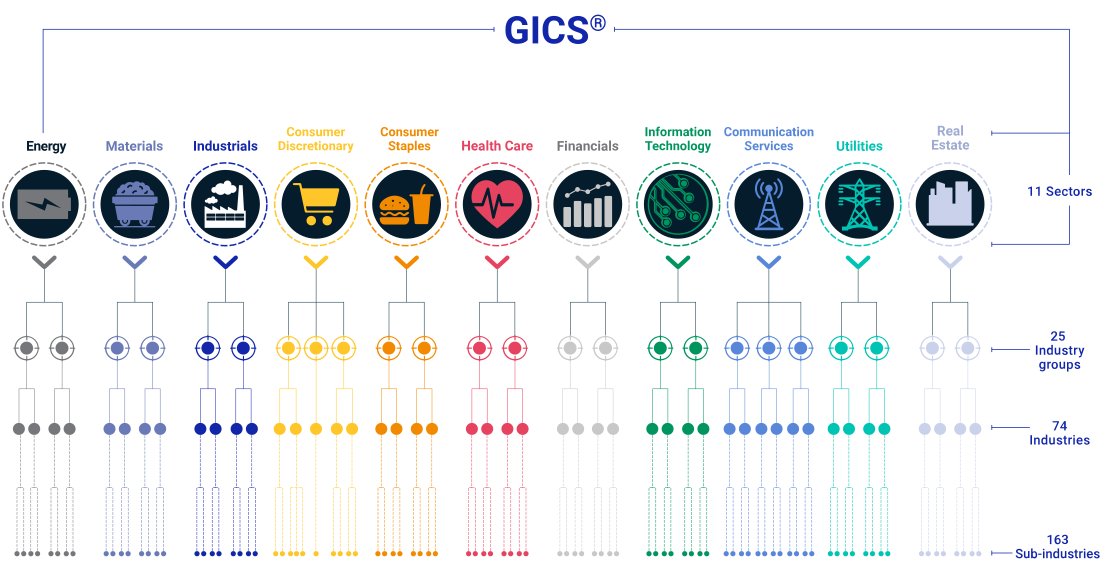
As long as you picked the right sector at the right time, growth persisted and market participants became entrenched.
Late 2000s-2022
Something interesting happened in 2008 – the financial crisis combined with the launch of the App Store marked a symbolic transition from sectors to tech, tech and more tech.
In 2011 we understood Why Software is Eating the World. Sector companies raced to adopt while investors looking for outsized growth focused on category prediction.
Mobile. E-commerce. Streaming. Biotech. Space. Sustainable Energy. While most of these were clearly tied to customer problems the more speculative ones weren't: VR/AR, IoT, Crypto and of course AI.
The latter one was the platform shift we'd been looking for all along and in 2022 everything changed.
2022-
Going forward, we have to develop a new understanding of how to identify growth pockets.
For every single category, it is not clear how much value will be captured by people who adopt AI versus “horizontal AI”. The reach of general purpose LLMs has already bled past ChatGPT wrappers into interfaces and horizontal players like Anthropic are going vertical too.
THE MARCH TOWARDS UNCERTAINTY
I see three distinct ways of thinking about the future.
A/ AI is just another technology
AI is adopted like software and the companies with the best customer relationships, domain expertise, brands and packaged vertical solutions continue to win.
In this world, current market boundaries hold and the strategy is to pick a domain and lead on AI adoption in that domain.
This is how it’s historically played out.
B/ Rebundling: the AI value chain
The “From Hierarchy to Intelligence” essay covered in our previous newsletter is a useful model here. Value accrues in two places: your defensible capabilities (data, proprietary processes, unique assets) and your ability to operate AI effectively. The interface, the thing you actually sell to customers, becomes a delivery mechanism rather than the thing that’s valuable.
Google Search is one example. Google’s underlying capability is indexing the web, scoring content, and rapidly serving answers. They monetized this through an advertising-funded interface. But in a world where Google wasn't doing Gemini, they would be forced to become an API and monetize differently.
This is happening across industries. Companies are getting compressed into their data moats and capability moats, and the margin that came from interfaces, human-delivered service models, or being the only option in a vertical, is rapidly shrinking.

C/ Capabilities become reproducible
At what point does AI become good enough to crawl enough data and cut enough deals to reproduce the Bloomberg Terminal from scratch?
There is a world in which the only thing that matters is how efficiently you convert compute into capabilities and products. The horizontal AI companies have an advantage here, they are the power users of the coding agents all the tools that will follow. Not to mention their marginal compute unit is cheaper.
This scenario would completely break our assumptions of how careers, companies, and investments work.
the uncertainty you’re feeling about predicting which markets will matter isn’t a personal failure of analysis. The map is opaque. The terrain is in flux. The neat circles we used to draw around industries and technology waves are not so neat anymore.
There are other factors these scenarios don't capture: battles over distribution, re-orientation around workflows or even the impacts of regulation.
So choose your own adventure:
If you believe workflows define the boundaries: build products that own end-to-end process outcomes and price this way.
If you believe orchestration is key, compete on reliability and feedback loops.
If you believe infrastructure commoditizes the entire value chain, invest/build around energy, compute and memory bottlenecks.
If you believe regulation will be the most impactful, develop AI for a high-compliance market.
etc.