


It used to baffle me how proud McKinsey Partners and Senior Partners were about how little they knew about technology. Knowing “the details” was seen as a sign that you are not senior enough so that other people can handle the details for you. The Partners and Senior Partners would instead focus on the big picture.
Well there is no big picture anymore.
OpenAI and Anthropic are entering the AI transformation space with two new heavily funded entities and it will shake things up.
In this essay I want to walk through:
How engineering has become a bottleneck for the AI rollout and why horizontal AI players are launching consultancies;
How will OpenAI/Anthropic solve this problem (it’s not what you think);
Why the Big Three should be very worried.
Engineering is still the Bottleneck
Both companies have spent the last year aggressively expanding enterprise tooling. Anthropic has Claude in desktop apps, vertical offerings, and a growing partner network. OpenAI launched Frontier in February and immediately signed Frontier Alliances with McKinsey, Accenture and others.
Yet adoption remains painfully slow.
It’s impossible to build “off the shelf” solutions for many enterprise problems.
For a stretch of my McKinsey tenure I was building the Firm's predictive maintenance “solution” (essentially using AI to predict when machinery would break).
This was not the same as building a SaaS tool. At times it meant flying to wind farms to physically extract sensor data from turbines because the infrastructure wasn’t connected to the cloud. The data was messy and sometimes data scientists had to create models just to clean it. Every client’s setup and data taxonomy was very different. Not to mention all machines had different characteristics.
So you have to do it bespoke.
But there are very few AI-native engineers and they don't emerge in these big companies nor in traditional consultancies where each engineer has many other things to do: creating presentations, talking to clients, reviewing work endlessly.
The Solution: Build Next-Gen Consultancies
The cloud providers (AWS, Azure) faced a similar problem a decade ago. When I was doing AI transformation work at McKinsey, we’d often partner with them because clients were bottlenecked on moving data to the cloud, figuring out the architecture, and identifying use cases. The cloud companies wanted to accelerate adoption because adoption meant compute spend.
Every workflow OpenAI and Anthropic automate inside a PE portfolio company will consume tokens indefinitely. So why not build the workflows themselves?
The only problem is that building a consultancy from the ground up and growing it fast is tricky. So they will be doing things a little differently than traditional consultancies.
Demand side: Partnering with Private Equity
PE firms are structured to transform the companies they own (that’s the business model). When I worked with PE portfolio companies at McKinsey, they were the most aggressive implementers. There was no internal resistance. Having access to a couple of the largest Private Equity companies in the world will provide a proactive client base on day 1.
Supply side: Scale through consolidation
Consultancies are very hard to scale since they require people to deliver the services (technology services or not) and it takes time to train them. Rumors are that these companies will seek to acquire and consolidate smaller service providers and that makes sense. I assume there will be a lot of poaching from Big Three as well (especially for the generalist consultants overseeing the transformations and maintaining relationships).
The Work is the Same
Aside from the hyper-scaling, however, I don't think these organizations will be as radically different from traditional consultancies as what people expect.
People describe this as if OpenAI’s research engineers are going to be personally deploying agents at mid-market insurance companies.
For a Big Three transformation, a typical engagement will look like this: 2-3 year transformation plan, prioritized use cases, small teams building proof of concepts, gradual rollout across the organization, and a training phase where internal teams learn to do it themselves.
The first few use cases get built with heavy external involvement. By the fourth or fifth, the client’s own team runs the project with oversight.
The other misconception is comparing this to Palantir. Yes, engineers will be forward deployed into client organizations, no doubt. But Palantir also built Vertical AI platforms. Anthropic and OpenAI don't really need to worry about this as their product monetizes at a lower level. I'm sure over time they will spin out additional vertical solutions that could be scalable but it will be hard to do so at first.
Another misconception I saw is comparing this to Sequoia’s Julien Bek’s essay on how automated consultancies will charge by objective.
In a previous piece, I laid out four layers in how AI reshapes knowledge work verticals: horizontal AI (the model companies), vertical AI platforms (tools like Harvey or Hebbia), neofirms (AI-leveraged consultancies like Crosby), and classical consultancies.
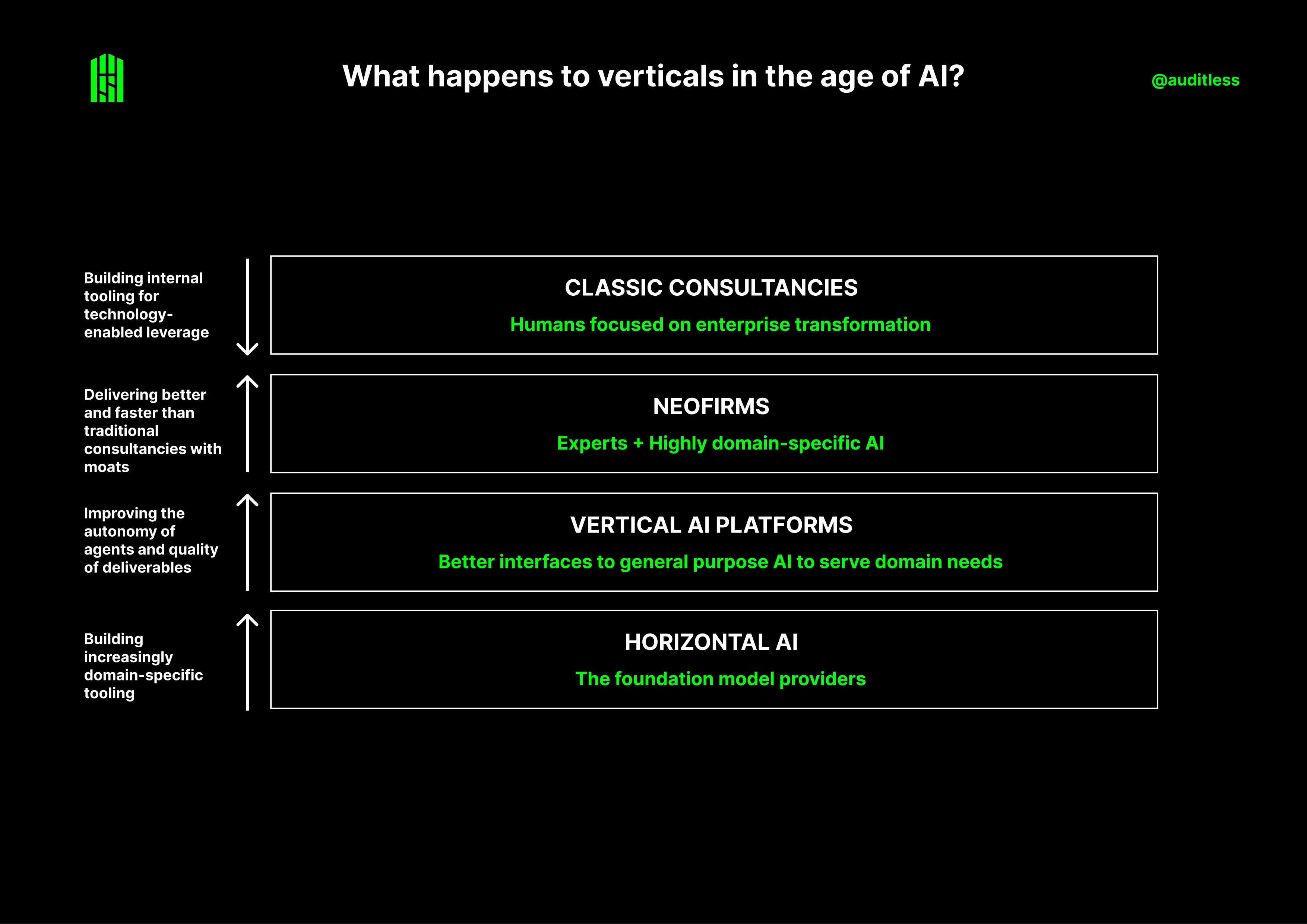
What OpenAI and Anthropic are doing is different from the neo firms AND vertical AI platforms that Sequoia’s thesis describes. The Deployment Company and Anthropic’s unnamed venture are will rather operate as Classic Consultancies focused on transformation.
Traditional Consultancies Should be Worried
First, AI transformation is rapidly becoming the only transformation that matters. Whether it’s a 5-year strategy problem or a pricing optimization project, it would revolve around AI.
Second, where are OpenAI and Anthropic going to find people who can run enterprise transformation engagements? A lot of consultants are going to find the OpenAI/Anthropic brands irresistible and move to build something new.
Third, the Senior Partner base at these firms has historically treated their generalist approach as an asset. The implicit belief is that deep understanding of business strategy transcends any specific technology. That worked when the most sophisticated piece of technology projects required was a spreadsheet.
It’s a liability when the technology is agents.
But it’s not going to be easy for OpenAI/Anthropic either.
Scaling a Consultancy is Hard
I'm going to repeat myself but multi-billion dollar valuations on day one are wild for companies that haven’t billed a single hour of consulting work.
You can’t 10x a consulting firm’s revenue by shipping code like you can in a SaaS company. Revenue is a function of how many skilled people you can deploy, how quickly you can train them, and how effectively you maintain client relationships across a growing portfolio. McKinsey has spent a century building decentralised project management, unified quality standards, and a culture of consistency.
The chaos of rapid acquisition and consolidation, which both entities will almost certainly pursue, adds another layer. Every acquihire brings different working styles, quality bars, and different client expectations.
Seeing them try to scale this fast will be exciting to watch, I'm sure won't be my last essay on the topic.
Facts.