

Ever since GPT-3.5 came out, I’ve been rethinking my assumptions about career, business, and impact what feels like every couple of months.
It’s tiring.
The pace of change in AI creates real anxiety in many people not because the possible outcomes are necessarily bad (despite what Citrini may think), but because the variety of possibilities is so vast that the uncertainty itself is paralyzing.
Where do you focus? What do you build? What do you believe in?
I’ve gone through enough of these cycles to arrive at a conclusion that feels almost too simple: pursue fun.
My thesis is that the people who are having the most fun are, counterintuitively, the people who are most likely to win.
The “Memetic Black Hole”
Despite each of us having access to the world’s knowledge and incredible creative tools, the 2020s have become the decade of uniformity.
Somehow, copying is the default. The algorithmic arena has flattened us. We are all looking at the same content (whatever peaks the algorithmic power curve), consuming the same feeds, reacting to the same discourse. And we have become disturbingly okay with imitation and repetition.
I still remember the 2010s when people would brutally take down companies for copying competitors. The early Chinese tech companies were dismissed as uncreative clones of Western products. Rocket Internet had a terrible reputation in Silicon Valley for copying US and Asian startups.
Now? A single piece of content or product gets replicated within days without ceremony. I call this a memetic black hole because the more we copy, the more we reinforce the notion that the only things that are successful are the same ideas and formats which then draws more people into copying.
One possible explanation is that we shifted our axis of competition toward distribution and away from product.
And then we convinced ourselves that distribution is a volume game: do the things that “work” (read: other people are doing them), just more of it without room for uniqueness or taste.
A New Hope
Craig Mod wrote something in his February newsletter that I keep coming back to:
the trick is to just keep making stuff faster than the machines can eat your purpose
Perhaps the response to a world of infinite replication is not to optimize harder but to produce from within.

This idea has also entered the mainstream with Alyssa Liu’s unprecedented return to the sport on her own terms and the famous line:
I connect with everything, but I'm not attached to anything
Fun is a Moat
But there are plenty of people embracing fun as a moat in a business context too.
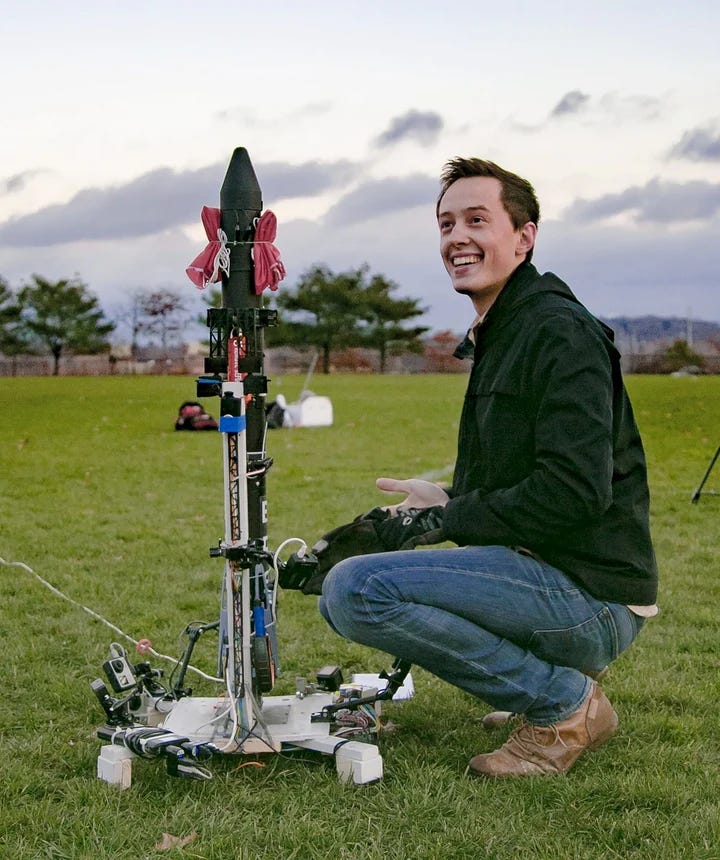
Joe Barnard studied music production at Berklee, saw SpaceX launches, and got hooked on rocketry. He started building model rockets in 2015 with zero engineering background, spent years failing, and eventually became one of the leading developers of model rocket stabilization. SpaceX and other aerospace companies made him job offers. He turned them down. His company, BPS.space, now sells flight computers and advanced rocketry kits. What looked like the silliest hobby project became a real business with real products, born entirely from following what was fun.
PewDiePie built a multi-GPU rig in his home and fine-tuned his own LLM.
Ironically, word “passion economy” was supposed to capture exactly this but soon became the creator economy.
But the actual advice given to creators became: pick a monetizable niche, find a blue ocean, A/B test your way to growth, etc. But what if the passion economy was exactly the right nomenclature?
Fun → Strategy
Here’s why fun works.
Fun differentiates you. Not everyone finds the same things fun. I find it fun to go to a pub and play games with 1993-94 vintage cardboard and I find obscure programming languages fun. It’s likely you don't share these interests.
That difference is, by itself, a form of differentiation. Instead of asking “how am I different?”, just ask: what do I genuinely enjoy?
Fun adds entertainment value, not just utility. I believe much of what we call the passion economy will shift from problem-solving toward connection and relatability. You are more trustworthy and magnetic when you are genuinely having fun than when you are visibly grinding for a monetary outcome.
Fun is more consistent than conviction. What we find fun is weirdly stable over time. What we believe will be valuable changes constantly. People have dipped in and out of crypto across three different cycles trying to time some big outcome. In the meantime they probably maintained the same hobbies. Following fun gives you more consistency, and consistency compounds.
Fun biases you toward doing, not talking. This may be the most important. When OpenClaw or any new tool drops, there are two types of content: “I built a 50-agent system that does something wild” and “how to install OpenClaw.” The people building the wild systems are the ones having the most fun. They’re too busy doing to write how-to guides. And their content is vastly more interesting, because it comes from a place of authority and genuine experimentation, not chasing trends.
Fun is cool. Fun impacts branding too. Take a company that makes paper and realizes they need a corporate mission. Suddenly the paper company is about “empowering people with knowledge.” Everyone knows it’s performative.
It would be more honest to just say: we obsess about paper a little too much, because we want to make the best paper possible.
Poolsuite is an extreme: an entire brand built around fun. Their whole identity radiates enjoyment. Fun makes for better branding.
I'm not advocating for laziness
Fun != easy. Some people love writing, but that doesn’t mean every writing session feels fun. Everything equal, writers would rather be the person in the cabin writing a book than the person in the office. But everyone has good days and bad.
On being early vs. late. You also can't be too shallow about where you find fun, or too static. If the only thing you find fun is watching Netflix, it’s going to be hard to build something around that.
It’s best if your fun is upstream of what other people will find interesting. If you’re just now discovering ChatGPT and finding it fun to play around with, maybe this is not the principle for you.
There’s hard work involved, but the struggle is worth it.
Velvet Noise put it well:
I think this is what happens when enough feedback loops have run their course. When you’ve been shaped by the right people, cracked open by the right questions, humbled by your own contradictions, and reflected on it all long enough to build an internal coherence. The static finally quiets and signal gets stronger. You stop performing and start expressing. This has nothing to do with magically figuring out who You are, but because you’re no longer afraid to show up as the version that’s real right now. You’re willing to speak as the person you are - in motion, in flux, but already worth hearing.
So go and have fun.