

Over a decade ago, Peter Thiel delivered his “Competition for Losers” speech at Stanford.
One of his core ideas was that there is a “right size” for a market you want to build your startup in. You want a small market so that you can dominate it and then maintain your monopoly as the market expands.
Too big and you won't be able to achieve a monopoly.
Too small and the market is irrelevant.
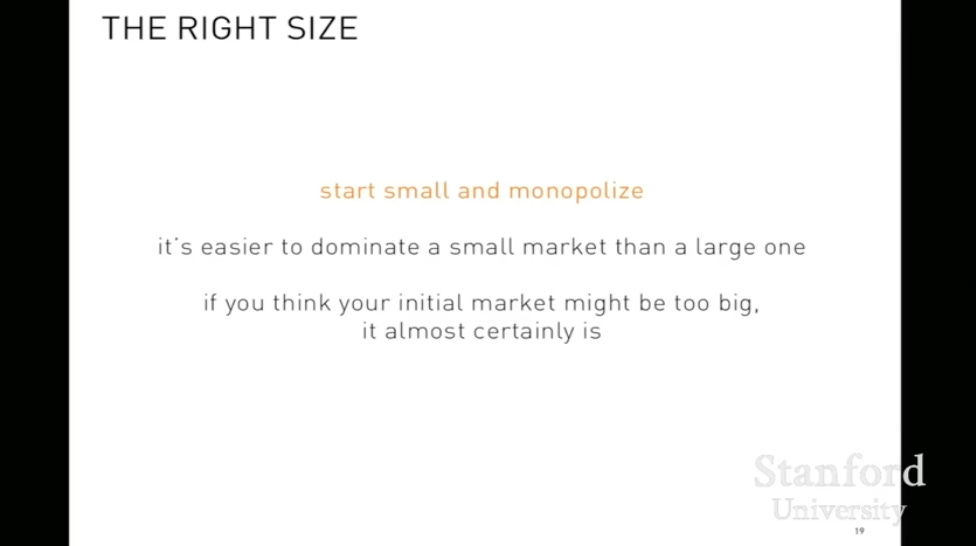
He goes on to convincingly establish the thesis but the obvious question becomes – how do you pick the right size?
The 100 Founder Heuristic
Around 2021-2022 I found myself as one of the many technical people in “Ethereum” – a pretty broad and lovely cohort of people.
My intuition was to niche down and focus on one area more deeply, I recognized that crypto was getting too big to be a generalist.
I picked ZK Rollups. In particular, I was one of the first developers on Starknet and got to know some incredible people both in the company and outside.
As a result of that choice:
I learned about Rollups and ZK, two areas I knew little about;
Auditless landed several grants working with rollups (Starknet/Unichain);
I made some angel investments into really talented people who became friends;
We built products that allowed us to make stronger contributions to Aera. In particular we were one of the early adopters of ERC4626;
I'm still collaborating with folks in the community to this day.
I think what made Starknet such a great community to participate in was a combination of the talent and the size.
These were some of the smartest people in crypto but there was less than 100 of them building at the time. As a result, everyone was keen to meet everyone and to support everyone else too.
I joined a 6-person meetup in London (which afterwards grew a lot) and helped host one of the first meetups in New York. Things grew quickly from there.
I say this because the mistake people make today is to think that they need to “move to AI”.
You are already in AI whether you like it or not.
What you need to do instead is be one of the first 100 Founders/operators in a smaller market and get to know everyone.
(This by the way is why people move to San Francisco, a lot of those communities physically exist there.)
I think that's roughly the right size that Peter Thiel was talking about.
I’ll leave you with a related thought from Alex Danco from How Scenes Work:
And part of the beauty of this book, this is not infinite games are good and finite games are bad. But the beauty of living life to its fullest is in choosing what finite games you play, that serve the infinite pursuits that you have. It’s picking. What finite game am I going to play in this scene? And does it really aligned with the infinite game I want to play of participating in culture?