


“We are not just here to build explorers”
This is the line I heard on the Trustless Agents Ethereum Community Call and it encapsulated my confusion with the new ERC-8004 standard.
This is a new standard for onchain agent registries that has gained popularity following the Trustless Agent Day at DevConnect. It has been compared with with Anthropic’s MCT, Google’s A2A and Coinbase's x402.
Here’s a summary from Hubble:
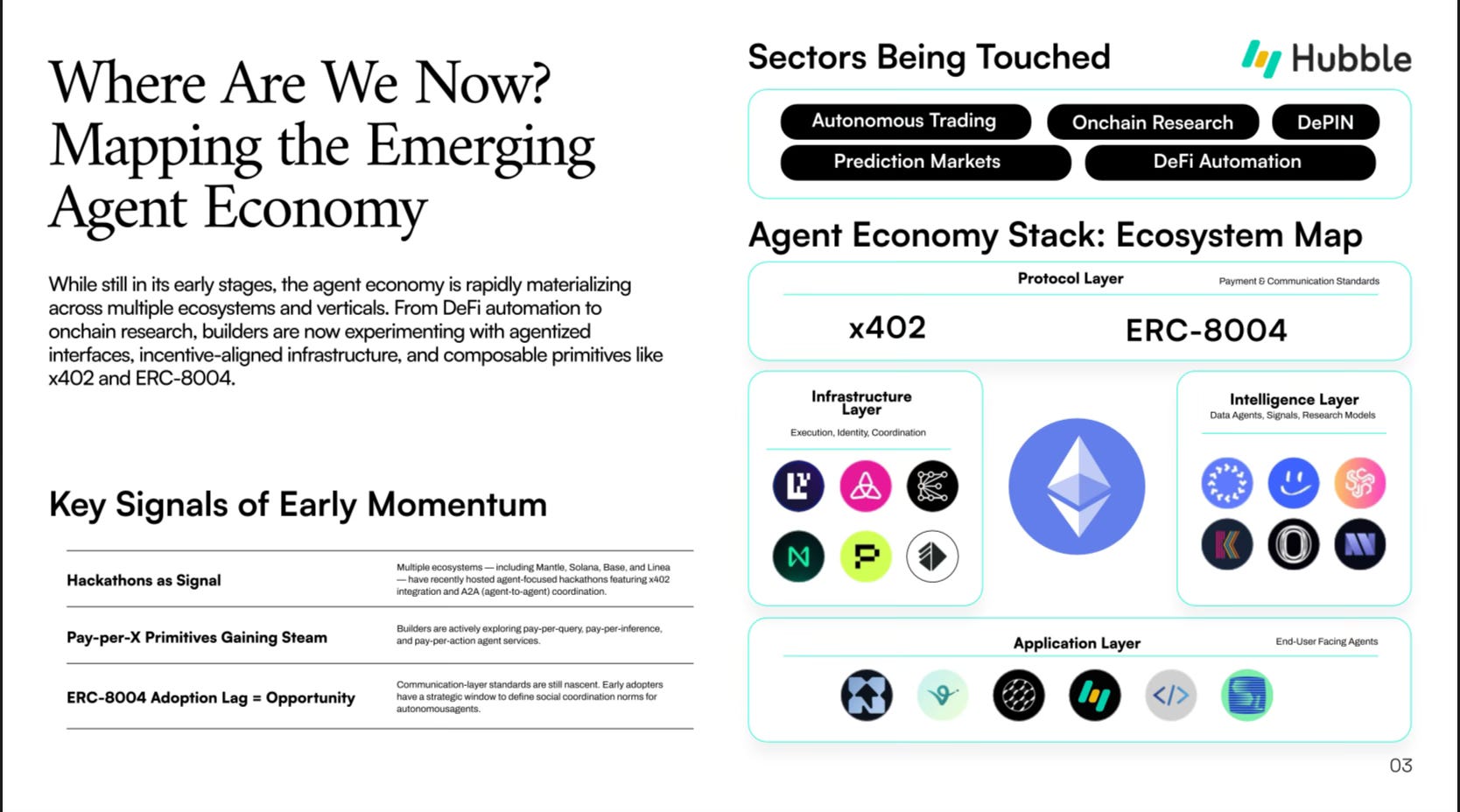
New chains and infrastructure teams in need of a growth narrative are latching on to ERC-8004 and everyone in crypto is writing explainers the “trustless agentic economy”.
I don't get it.
The messaging around ERC-8004 is really vague:
“It enables onchain economies”;
“It enables trustless agents”;
“It enables agentic finance”.
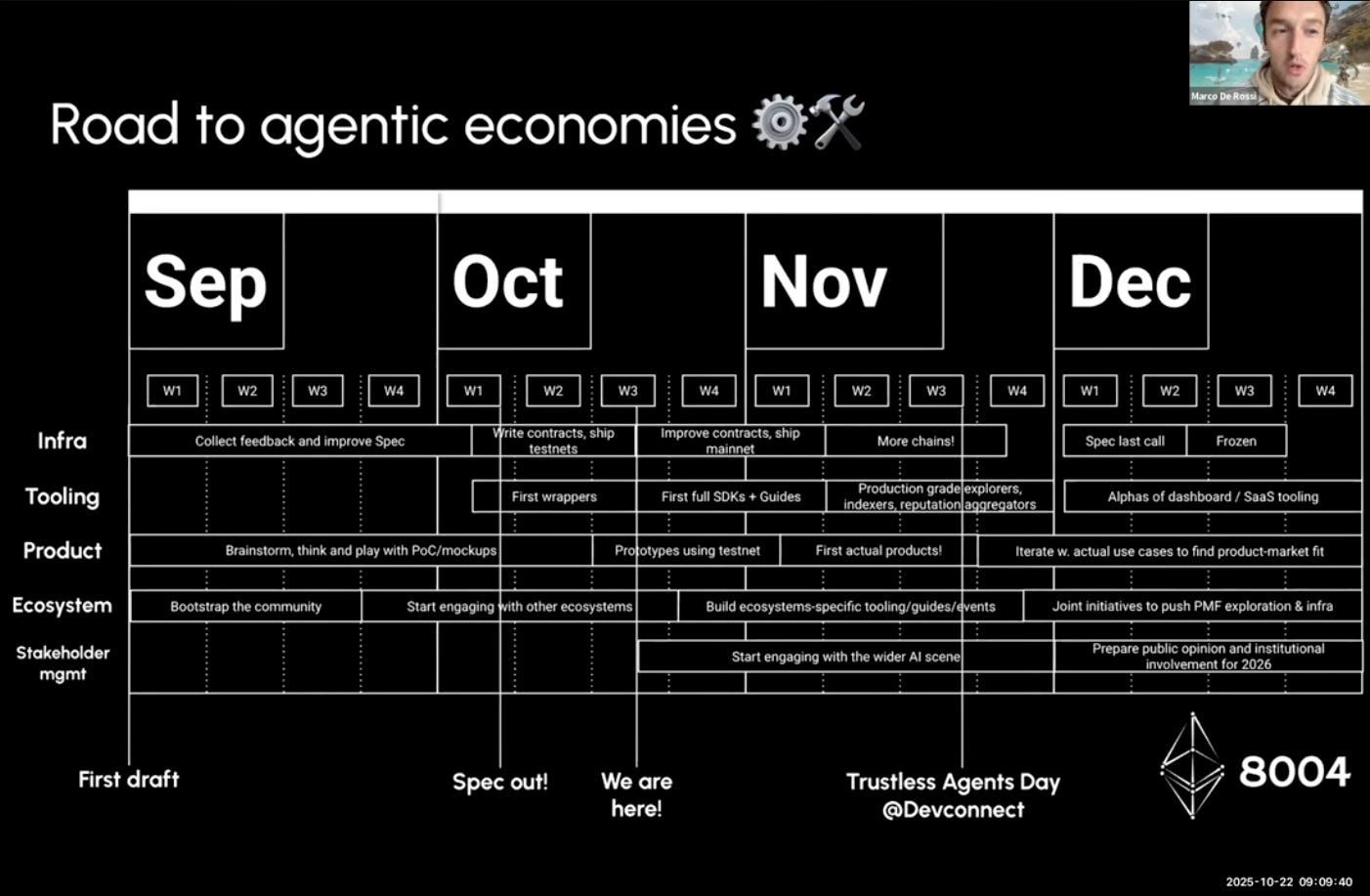
This doesn't just come from ChatGPT generated blog posts, this language is used in the official roadmap (NOTE: finding actual use cases is a task for December in small print):
We already learned the lesson with stablecoins. New entrants like Stripe and Robinhood aren't talking about “enabling DeFi”, they are talking about how stablecoins are cheaper/faster to transact with, easier to access, available 24/7, etc. I wrote about this here:
The other pissed off group are people who thought they would win crypto just because they were early. They expected the complete dissolution of tradfi and hoped that their little startup will end up hiring JP Morgan VPs as they flee to become degens. Instead they now see they will be crushed by tradfi companies like Robinhood who have brand recognition, regulatory moats, people that actually work hard, a focus on user experience, trust with their customer and so on. It’s over.
I think crypto agents may be suffering the same fate. People think that just identifying and riding the trend is enough to win; in reality that’s far from the case.
Especially in the early days of a new trend forming, you need to cut through the crap – that’s what I'm here to do now.
WHAT IS ERC-8004
ERC-8004 establishes an onchain registry for agents.
It’s a smart contract registry of agents with three components.
Identity Registry
Basically points to a registration document for each agent, which looks like this:
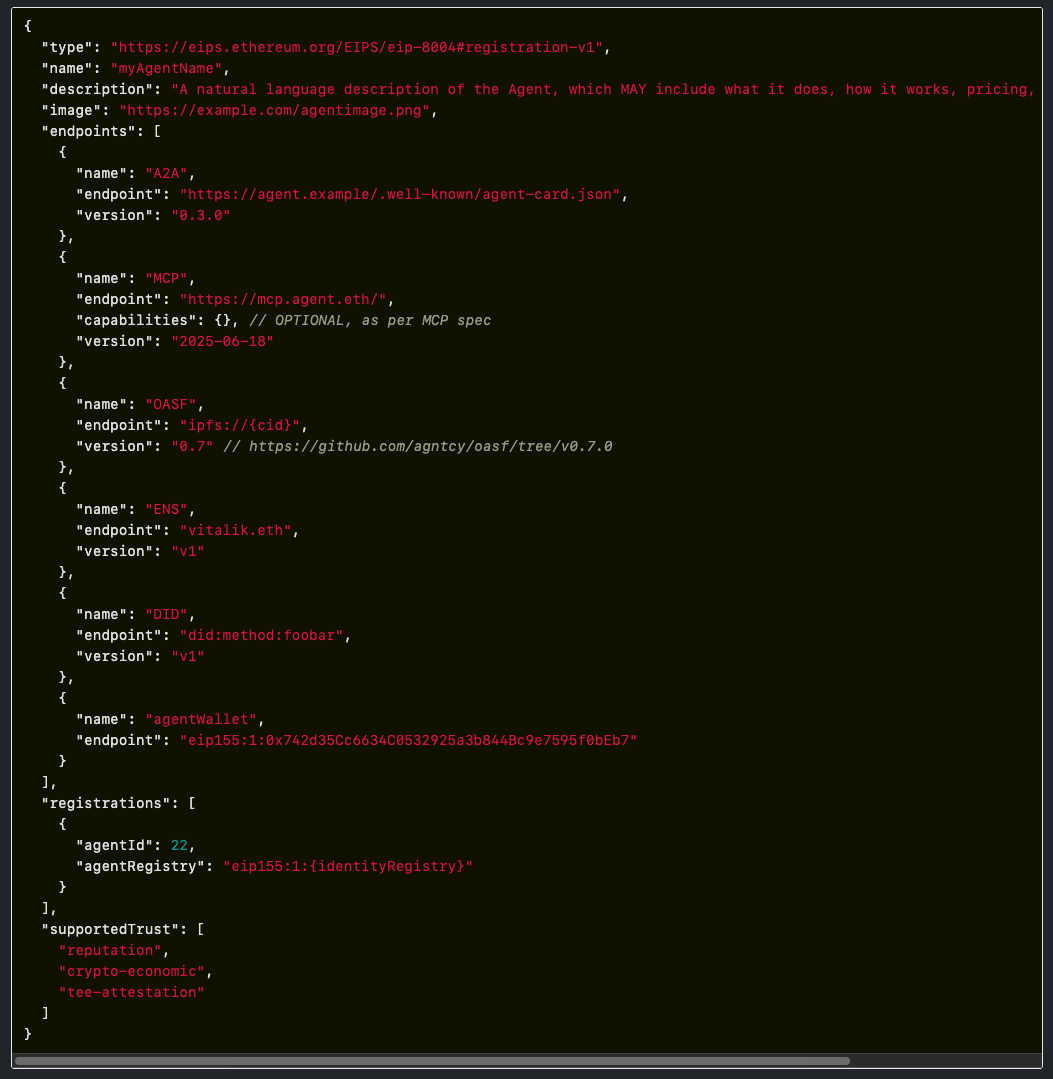
One cool thing about the registry is that it is an ERC721 contract (read: NFT collection) where each agent corresponds to an individual NFT.
In addition, arbitrary metadata can be set on an agent such as additional wallet addresses.
Reputation Registry
The reputation registry allows consumers of the agent to submit “feedback” and have that automatically be aggregated.
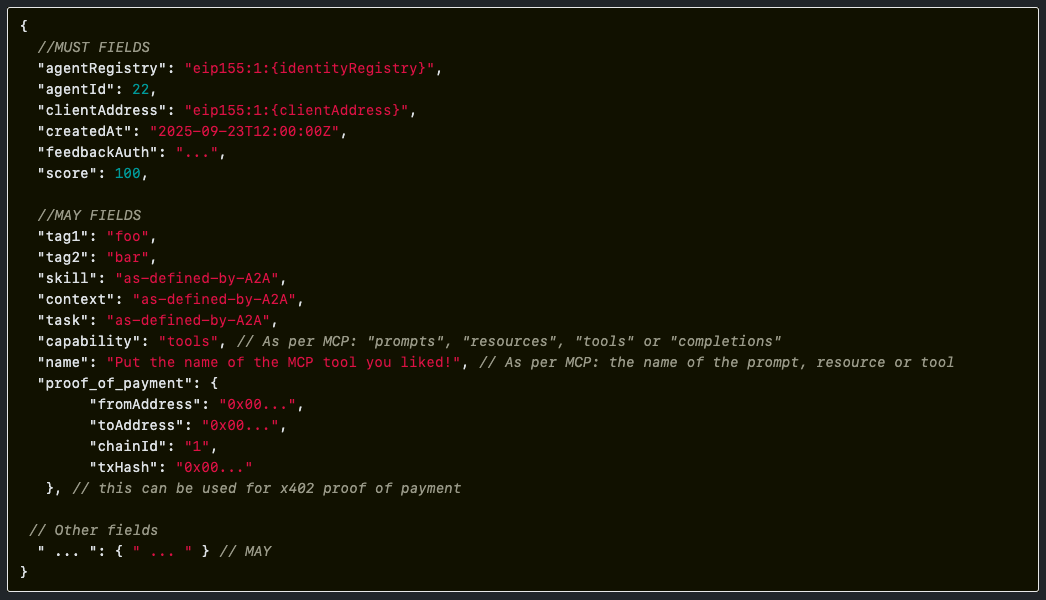
The feedback can only be submitted by a real client, somebody who asked the agent to complete a task. The feedback includes a 0-100 score, two tags and a link to a JSON file for additional information.
Any client can give feedback by calling giveFeedback or revoke it by calling revokeFeedback.
The standard motivates building custom reputation systems that process and aggregate feedback into reputation scores.
This is an example of what a feedback file could look like:
Validation Registry
These are hooks to use deterministic validation methods to validate task outputs.
The agent owner calls validationRequest to request a specific validator to validate a specific set of tasks and the validator responds by calling validationResponse, providing a score from 0-100.
This is comparable to task validation in Bittensor subnets (although those are not specific to agents).
THE MANY FLAWS OF ONCHAIN REGISTRIES
This all sounds good in theory.
If you think of this as an onchain marketplace for agents like Uber, we have some of the key ingredients:
The profile of an agent (the rider);
Their “rating” in the form of reputation;
A way to validate their outputs (equivalent to GPS-based rider tracking in Uber.
But there are two huge challenges: getting people to use the open marketplace and security.
In the early days of crypto, there was an idea called token curated registries which would use a token to incentivize people to maintain registries (e.g., a top 100 movie list). People even wrote papers supposedly proving that there would be enough of an incentive for theses lists to get accurately maintained.
Here’s a line that people tended to use:
The intrinsic tokens of token-curated registries are necessary elements of self-sustaining systems which are public utilities. Token-curated registries are peak predators of capitalism that perform a useful function at the lowest possible marginal cost.
In practice, none of the token-curated registries got any adoption.
Agent marketplaces will absolutely exist but why would they publish all their data in the open?
In almost any market, the winning marketplace is one that offers significant additional value or has the strongest network effect. Publishing your “supply” into an open registry removes the network effect moat altogether. The Apple App Store proposes native access to the most affluent large mobile phone user base AND comes with a custom programming language and SDK specialized for phone development.
Do you really believe the winning agentic marketplace will be onchain vs. from OpenAI?
One argument for using these registries is that there are people who care to consume agents “trustlessly” and don't want to go through a centralized platform.
But this registry:
Doesn't host the agents;
Doesn't hold the agent developers legally accountable in any way;
Doesn't provide a way to validate if the feedback provided is actually valid (and not provided by competing agents, for example).
The best marketplaces are not trustless, they provide a lot of tools to help you trust the other marketplace participants.
Which brings us to the security issue. None of the underlying mechanisms is bulletproof. Restricting feedback to only be submitted by verified clients is a very weak and clearly insufficient form of validation.
Lots of additional infrastructure needs to be built on top here to actually produce a robust reputation oracle for agents.
And even then, the agent developer can change the source code of their agent at any point (unless you are using specific validators via TEEs).
THE BULL SIDE
I guess my point isn't that these registries are completely useless, it’s just that we are too early in the agent lifecycle for people to pick agents from an onchain marketplace.
Agents hiring agents
There are use cases that could benefit from an onchain registry such as agents discovering other agents and then enlisting them to complete tasks.
Tokenized marketplaces
Perhaps some protocols figure out a way to make open marketplaces work through tokenomics (such as rewarding agents for receiving positive reputation).
Not just agents
Finally, I compared the interface before to the Bittensor validation process. I think this standard is broad enough to be adopted in use cases that aren't just agents (or equivalently, the interface for an agent is broad enough to interface over programs, data and other non-agentic entities).
I think this is a good long-term discussion to have but right now we just need to solve real problems like delivering yield to users through agents and making the first truly useful agents.