


Last year, I wrote about how composability has influenced the AI form factor, notably pushing more serious users towards CLIs:
Composability is what initially drew me to blockchains and I think is the reason why CLI interfaces have been so successful in coding.
There are an infinite amount of workflows which are enabled by the flexibility of these interfaces:
Working remotely via SSH (e.g., working from an iPad);
Running multiple agents in parallel;
Configuring agents (simply using local Markdown files);
Using the CLI as an MCP tool in another agent;
Using the CLI for one-off tasks (even using it from other tools, bash scripts or other coding agents);
etc.
As an unfortunate side effect, non-technical users were consequentially gate-kept from running agents autonomously.
All that changes with the release of Claude Cowork (available for Claude Max users in a research preview), which provides Claude Code-like agentic capabilities in an Electron Mac app.
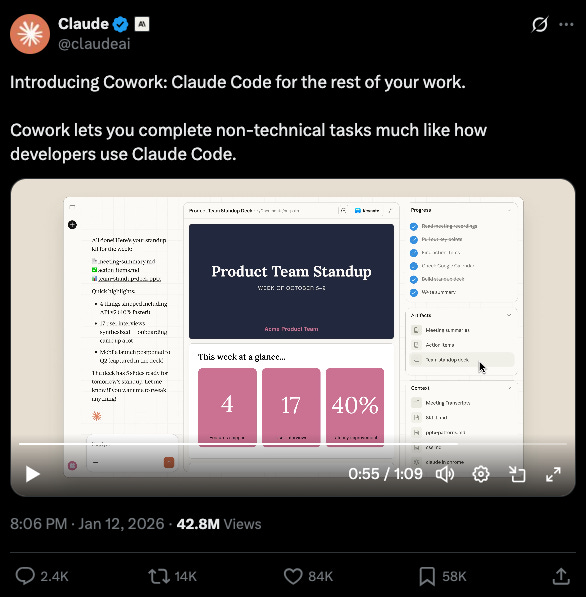
It’s positioned as an experiment with the first iteration taking just 1.5 weeks to build according to Felix from the Anthropic technical team.
But the timing for the POC is perfect. Many people have already been diving into Claude Code over the holidays and will be relieved to find they won't have to learn Bash, Git, Markdown, tmux anymore to run long-running jobs.
Is this as good as Claude Code?
IT’S STILL JUST A UI
When I explained why CLIs are so powerful, it wasn't just that a CLI has access to the host’s computer. It's that the CLI can be invoked in various ways. “Ralphing” as described in last week’s issue is the perfect example of something that is easily done with Claude Code but impossible to do with Claude Cowork.
Moving from tool-enriched “chat”, a single-threaded conversation which is effectively just a context filling hack to “cowork”, an agentic loop is a big deal. Being able to run many cowork agents in parallel is also a really big deal. But one last important step is missing: programmatically invoking cowork agents.
Still, Claude Cowork can do a lot:
It can access your computer’s file system;
It can access your emails/calendar and use other common integrations AND it has the horsepower to actually process much more data in these applications to do things like comprehensive calendar audits or email summaries;
It can even use a Chrome browser and interact with applications that may otherwise not have tools/apps. Even using tools to create presentations.
NON-CODE MEDIA
There is another reason why Claude Code has been so powerful and we should temper our expectations with Claude Cowork.
Coding is highly deterministic: you have tools to robustly check syntax, strict conventions for how to do things like writing comments and naming variables as well as ways to test for correctness.
Any vibe coder knows that you can iterate any app idea into submission by simply continuing to test & try the app.
The same is not true for getting AI to write coherent thoughts, generate beautiful images or completing long-standing research tasks. You can often get it to work but things don't get better with iteration the same way that code does. Often you get some sort of prompting insight that creates a step-change in output. And often that prompting insight is not necessarily applicable across domains.
Coding with agents is easy, nobody has yet figured out the playbook how to make world class presentations, spreadsheets, etc. I’m curious how that plays out. Couple of options:
1/ Operate on the prompt
The answer could be that you need Claude Cowork to iterate in a feedback loop on its own prompt as opposed to the artifact itself. So you'd iterate on the perfect spreadsheet writing prompt as opposed to tweaking the spreadsheet itself.
2/ Reduce everything to code
You can build presentations with Beamer, spreadsheets with Incremental and gifs with Processing. All in code. It’s possible that coding agents will become so powerful that it will be easier to let Claude Code write LaTeX for your presentation as opposed to letting it stumble around in Keynote or Google Slides.
It will be cool to see applications of AI extend beyond coding, slop content and reply bots on X into regular enterprise workflows but expect adoption to be a little slower. Developers love trying new tools way more than the average person in marketing & sales.