

The Personal Computer Revolution allowed individuals to directly access software at home (and in more offices). Companies that understood how best to use software (or better yet develop it) thrived. A class of jobs we now call “knowledge work” emerged and over time became synonymous with effective computer use.
As an engineer, I needed to be proficient with an IDE. As a consultant, PowerPoint, Excel and the browser were more important.
When Ray Dalio wrote Principles, he described ways managers can think about the organization and their role in it.
He compared effective management to operating a machine.
Until now, most of us didn't have the privilege of a managerial position and by extension the ability to “build a machine”.
Now we do.
I believe “building the machine” and operating it is precisely the skill that matters as we shift to agentic work and both individuals and companies are now in a race to build the machines up.
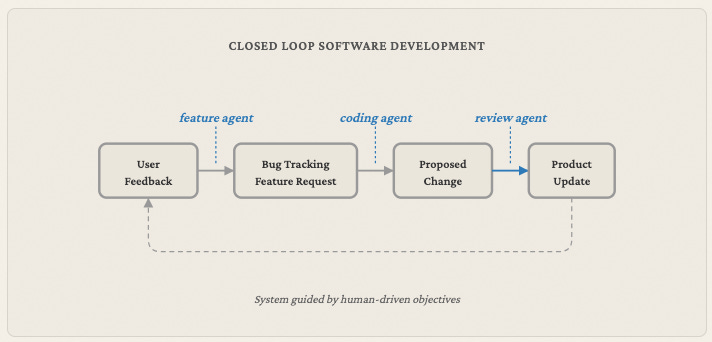
Benedict Brady’s essay about Closing the Software Loop points to what the endgame looks like in software development: a system that continuously collects user feedback, interprets and implements it with dedicated agents.
There are FIVE STAGES to ASCEND
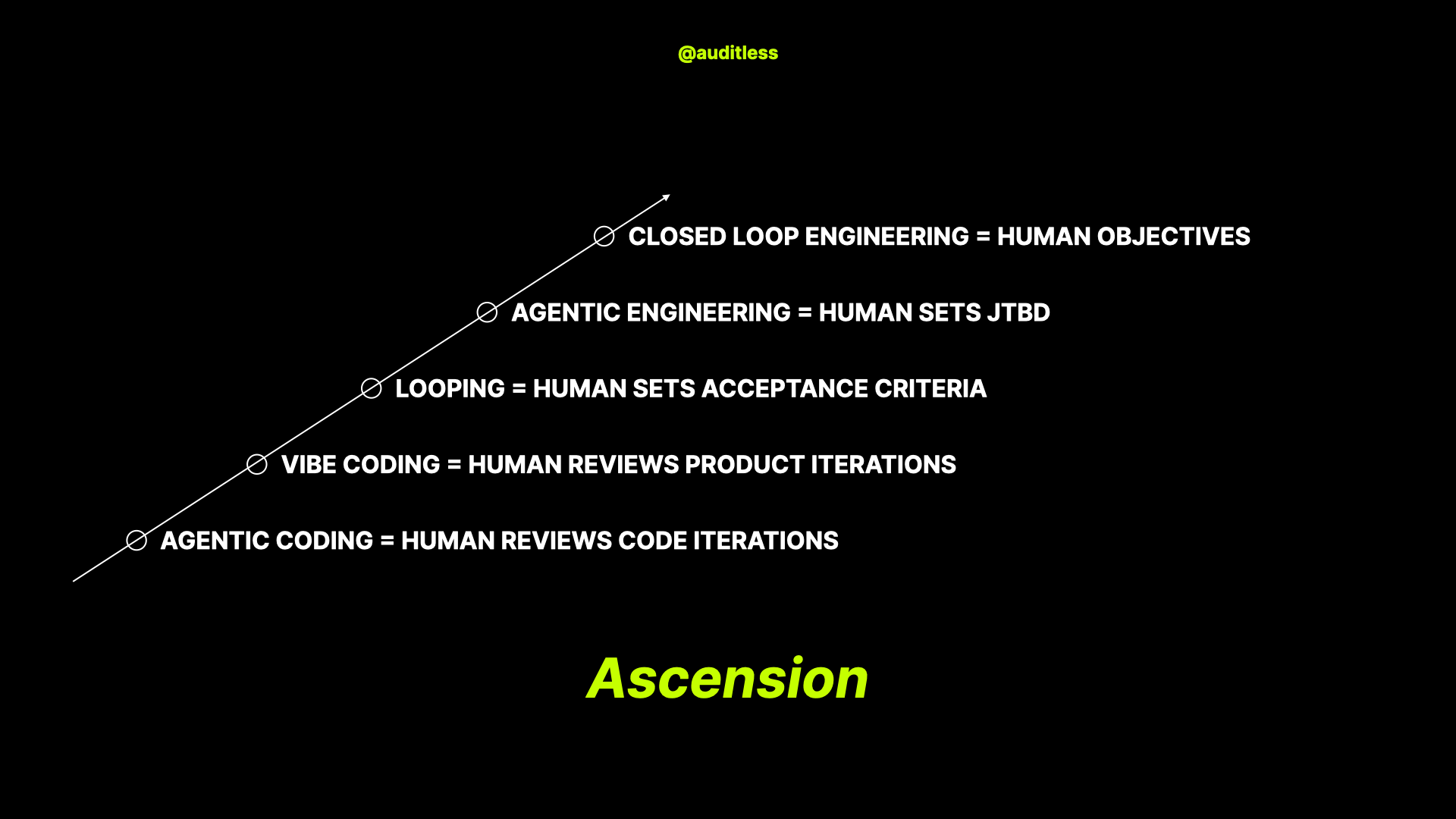
Agentic Coding is where people who tie their identity to being good developers often get stuck in. Humans review every piece of code and often focus excessively on form over function, getting very little done in the process.
Vibe Coding is the default non-technical entry point. Punch in a few prompts, get a UI back and keep prompting until you get loosely what you want. Who know’s if it’ll work?
Looping is where the prompter starts to carefully define not just the work itself but relevant acceptance criteria: tests, feedback loops, audit processes, etc. The work itself is often conducted in a repeated loop until all the acceptance criteria are fulfilled. For more details on “Ralphing” as one way to do it read our post.
Agentic Engineering is where the user starts to become an orchestrator of several different agents often working in parallel. There’s enough orchestration that the human can simply describe the problem to be solved (Job to be Done) and a planning agent, coding agent and review agent can work together to find a solution.
Finally, Closed Loop Engineering is the holy grail. This phase aims to entirely automate the job of 1 Product Manager and their entire Engineering team, a unit that when horizontally scaled can match the output of an entire software company. The hardest part here is finding ways to gather and sort through human feedback in an unexploitable way and translate it into roadmaps.
WANT to play a GAME?
I think the game is moving up these levels for as many projects that you are currently tackling and then do many that you can't even imagine.
Your goal is to maintain and enhance the closed-loop machine by observing its performance and ability to achieve goals you set for it. At times, you can insert yourself in the machine, but devoting too much time to that builds a machine that is necessarily bottlenecked by the human in the loop. A machine that doesn't work when you sleep.
I actually started sleeping better when I realized this. The existential dread started washing away a little bit. I started to see exactly how having some combination of software development, product management and consulting skills will help me build up this machine faster.
It would be a mistake to think that traditional jobs and skillsets are going to stay the same. It’s also a mistake to think that we will be vulnerable to immediate automation. The reality is in the middle: there is a new game, a new skill to master.
We are all building verticalized machines that aim to replace what each of us could have done with the help of an entire team.
Verticalized because your taste (not your skill) provides a quality ceiling on the machine’s output and your existing experience is an accelerator in getting the machine and its playbooks up to scratch.
Let’s play.